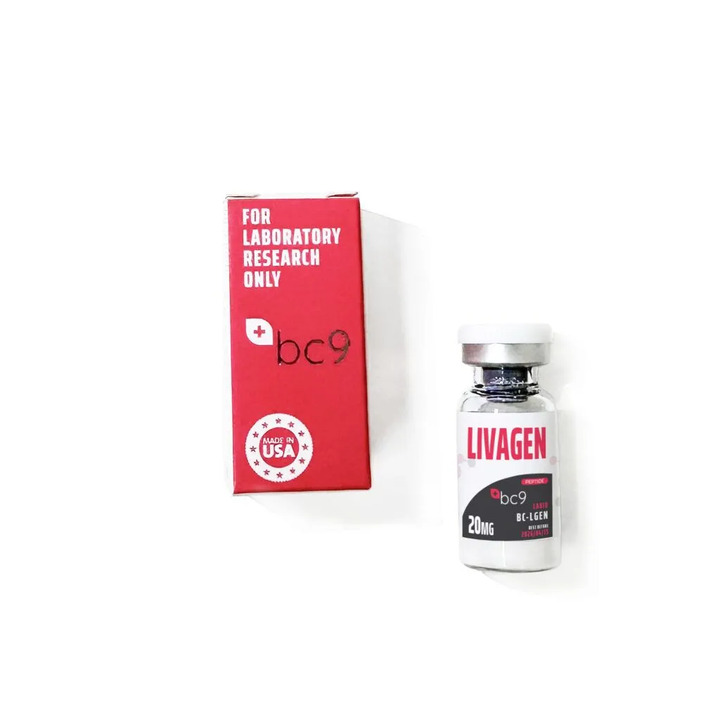
The Livagen peptide has emerged as a subject of focused scientific interest due to its distinct molecular composition and its association with cellular regulation pathways. Originally explored within peptide bioregulator research, Livagen is studied primarily for its interaction with liver-associated cellular mechanisms and its broader implications in peptide signaling science. As peptide research advances toward higher specificity and targeted biological modeling, Livagen peptide occupies a niche defined by precision, structural simplicity, and reproducible synthesis.
Origins and Discovery of the Livagen Peptide
Livagen belongs to a class of short-chain synthetic peptides inspired by naturally occurring peptide regulators. These compounds were initially conceptualized to mirror endogenous signaling fragments involved in tissue-specific cellular communication. Livagen was specifically developed to reflect peptide sequences associated with hepatic cell environments, making it a focal point in liver-related molecular research models.
Early laboratory studies prioritized Livagen due to its minimal amino acid length, which allows researchers to isolate peptide–cell interactions without confounding structural complexity. This origin places Livagen peptide firmly within modern peptide biochemistry rather than botanical or hormonal research categories.
Molecular Structure and Amino Acid Composition
At the molecular level, the Livagen peptide is characterized by a short amino acid chain engineered for stability and consistency. Its low molecular weight supports high bioavailability in controlled research environments and facilitates transport across cellular membranes in vitro.
Key structural attributes include:
- Defined amino acid sequencing for predictable folding behavior
- Resistance to rapid enzymatic degradation under laboratory conditions
- High purity potential during synthesis via solid-phase peptide synthesis (SPPS)
These properties make the Livagen peptide particularly valuable for mechanistic studies where reproducibility and molecular clarity are essential.
Cellular Interaction Pathways
Research interest in the Livagen peptide centers on its interaction with intracellular signaling pathways associated with liver cell metabolism and regeneration models. While not classified as a hormone or enzyme, Livagen is examined for its ability to influence gene expression signaling cascades indirectly through peptide–DNA and peptide–protein interactions.
Observed research pathways include:
- Modulation of transcription factor activity
- Support of peptide-mediated cellular communication models
- Interaction with peptide-responsive receptor systems in hepatic cells
These pathways are investigated strictly in research settings, emphasizing mechanistic understanding rather than clinical application.
Research Applications of Livagen Peptide
The Livagen peptide is utilized exclusively within laboratory and academic research frameworks. Its primary applications include:
1. Peptide Bioregulator Studies
Livagen serves as a model compound in peptide bioregulation research, allowing scientists to study how short peptides influence cellular behavior without the complexity of larger proteins.
2. Hepatic Cell Line Modeling
Due to its origin concept, Livagen peptide is frequently examined in liver-derived cell cultures to observe peptide-driven responses under controlled conditions.
3. Molecular Aging and Cellular Turnover Research
Some studies incorporate Livagen into broader peptide research exploring cellular renewal, transcription stability, and intracellular communication over repeated replication cycles.
Stability, Handling, and Storage Considerations
From a research logistics standpoint, Livagen peptide demonstrates favorable handling characteristics:
- Stable in lyophilized form when stored at low temperatures
- Compatible with standard laboratory solvents used for peptide reconstitution
- Maintains structural integrity across short experimental timelines
These features enhance its suitability for repeat experimental protocols and longitudinal studies.
Comparison With Other Synthetic Peptides
Compared to longer regulatory peptides, Livagen offers:
- Reduced synthesis variability
- Lower risk of conformational instability
- Faster integration into experimental systems
This positions the Livagen peptide as a preferred option for researchers prioritizing clarity of peptide action over multifunctional complexity.
Ethical and Regulatory Research Context
Livagen peptide is classified strictly as a research compound. It is not approved for therapeutic, diagnostic, or dietary use. All investigative work involving Livagen is conducted within regulated laboratory environments, aligning with established peptide research standards and institutional review requirements.
Future Directions in Livagen Peptide Research
Ongoing investigations continue to refine the understanding of how the Livagen peptide influences cellular signaling efficiency and transcriptional regulation. Advances in peptide synthesis and analytical instrumentation are expected to expand its role as a reference compound in peptide-based molecular research.
Conclusion
The Livagen peptide represents a focused and structurally efficient tool within modern peptide science. Its origins in bioregulator research, combined with its well-defined molecular architecture, make it an essential compound for laboratories exploring peptide–cell interactions, hepatic signaling models, and controlled molecular response systems. As peptide research evolves, Livagen remains relevant due to its precision, stability, and applicability across diverse experimental frameworks.