Power Tools Market Set for Strong Global Expansion as Construction and DIY Trends Surge
Market Estimation & Definition
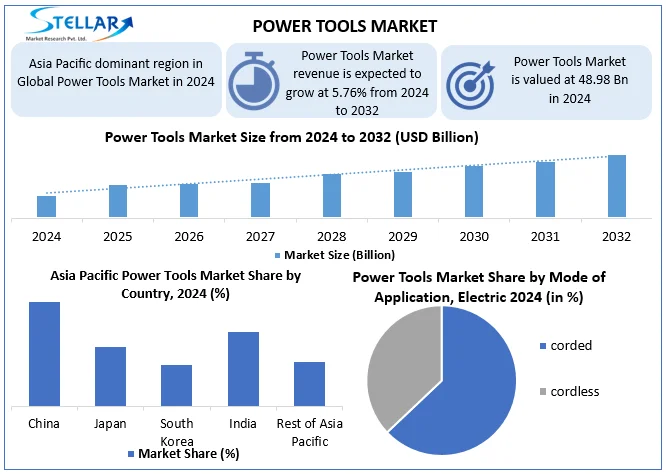
The power tools market refers to the global industry for electrically powered handheld and stationary tools used in construction, industrial, woodworking, automotive, and home improvement applications. These tools — including drills, saws, grinders, sanders, rotary hammers, and impact drivers — replace manual labor with faster, more efficient power‑assisted operations, greatly enhancing productivity and workmanship. According to Stellar Market Research, the global power tools market was valued at approximately USD 28.52 billion in 2024 and is projected to reach about USD 46.80 billion by 2032, expanding at a compound annual growth rate (CAGR) of 6.1% during the forecast period.
Market growth is being driven by expanding construction activity worldwide, rapid industrialization, and growing interest in home improvement projects among consumers — positioning power tools as both essential professional equipment and popular household items.
Request Free Sample Report : https://www.stellarmr.com/report/req_sample/power-tools-market/2591
Market Growth Drivers & Opportunity
A central driver of market expansion is the boom in residential and commercial construction across both developed and emerging regions. As urbanization increases and infrastructure investment rises, contractors and tradespeople are intensifying the use of power tools for faster build cycles and higher efficiency. The launch of government‑backed infrastructure programs in regions such as Asia Pacific and North America continues to support steady demand.
Demand is also propelled by the DIY (do‑it‑yourself) trend, which has grown in recent years due to rising home renovation activities and consumers seeking personalized home upgrades. Online tutorials and easy‑to‑use power tools have lowered the entry barrier, encouraging hobbyists and homeowners to invest in their own toolkits.
Technological advancements — particularly the shift toward cordless and battery‑powered tools — are unlocking additional opportunities. Lithium‑ion battery technology, improved charger systems, longer run times, and brushless motor designs are enhancing tool performance and portability, making cordless power tools increasingly preferred over corded alternatives.
Industrial growth is another key factor. Industries such as automotive, metal fabrication, and shipbuilding leverage power tools for precision tasks, machine maintenance, and assembly line work, contributing to recurring demand from commercial sectors.
What Lies Ahead: Emerging Trends Shaping the Future
Several important trends are shaping the future landscape of the power tools market:
-
Cordless Innovation: Cordless tools continue to outpace traditional wired tools, driven by improved battery performance, safety advantages, and convenience for use in remote locations without easy access to power outlets.
-
Smart Tools and Connectivity: Manufacturers are integrating IoT and sensor technologies into power tools, enabling features such as tool tracking, system diagnostics, automatic speed regulation, and preventive maintenance monitoring. Connected tools help fleet managers optimize deployments and reduce downtime.
-
Ergonomics and Safety: Product design increasingly emphasizes operator comfort and safety, with better grip systems, reduced vibration, lighter materials, and enhanced protective guards — features especially valued among professionals.
-
Rental Services Growth: Tool rental services, particularly in emerging markets, are gaining popularity. These services allow businesses and consumers to access high‑end tools without large capital expenditure, supporting adoption among budget‑conscious users.
-
Green Energy Integration: As awareness grows around sustainable practices, manufacturers are developing more energy‑efficient motors, lower emissions designs, and battery recycling initiatives.
Request Free Sample Report : https://www.stellarmr.com/report/req_sample/power-tools-market/2591
Segmentation Analysis
The power tools market is segmented by type, power source, end‑user, and distribution channel:
-
By type, categories include drilling & fastening tools, cutting tools, grinding & polishing tools, and others. Among these, drilling & fastening tools account for a major share due to their widespread use across construction and industrial applications.
-
By power source, tools are divided into corded, cordless (battery), and pneumatic segments. The cordless segment is witnessing the fastest growth, attributed to increasing portability and improvements in battery technology.
-
By end‑user, the market is driven by both professional users (contractors, builders, manufacturing sectors) and DIY consumers. Professional demand continues to dominate due to project requirements, while DIY demand is notable for steady penetration in residential markets.
-
By distribution channel, power tools reach consumers through online retail, specialty tool stores, hypermarkets & supermarkets, and industrial distributors. Online sales are expanding rapidly as e‑commerce platforms gradually become preferred purchase points for both individuals and enterprises.
Country‑Level Analysis
In North America, the United States remains a key market owing to strong construction activity, renovations, and robust industrial sectors. Consumer spending on home improvement projects further amplifies demand for both professional and DIY power tools.
In Europe, countries including Germany, the UK, and France hold substantial market share due to established manufacturing industries, stringent quality standards, and high worker productivity requirements. The European emphasis on safety and compliance supports ongoing investments in advanced power tool technologies.
The Asia Pacific region is poised for the highest growth rate, led by expanding infrastructure development, rising disposable incomes, and industrialization across China, India, Japan, and Southeast Asian economies. Rapid urbanization and localized manufacturing investments are primary contributors to sustained market expansion.
Commutator Analysis (Competitive Landscape)
The competitive landscape of the global power tools market includes major multinational brands and several regional players focused on innovation, product reliability, and global reach. Prominent companies include Stanley Black & Decker Inc., Robert Bosch GmbH, Makita Corporation, Hitachi Koki, Techtronic Industries Co. Ltd. (TTI), Metabo, Milwaukee Tool, DeWalt, and Festool.
These players continuously introduce updated product lines with higher performance, ergonomic design, and advanced battery systems. Strategies such as partnerships with distributors, expanded aftermarket services, localized production, and digital marketing efforts help companies expand market share. Companies are also engaging in strategic acquisitions and R&D collaborations to stay competitive in a rapidly evolving market.
Press Release Conclusion
The global power tools market is poised for robust growth through 2032, underpinned by rising construction activities, growing DIY culture, and technological shifts toward cordless and connected tools. With expanding opportunities in emerging regions and steady demand from professional end users, the sector is well positioned to capitalize on innovation and rising consumer expectations. As manufacturers continue to enhance performance, safety, and usability, power tools will remain integral to modern construction practices, industrial operations, and home improvement trends worldwide.
About us
Phase 3,Navale IT Zone, S.No. 51/2A/2,
Office No. 202, 2nd floor,
Near, Navale Brg,Narhe,
Pune, Maharashtra 411041
sales@stellarmr.com