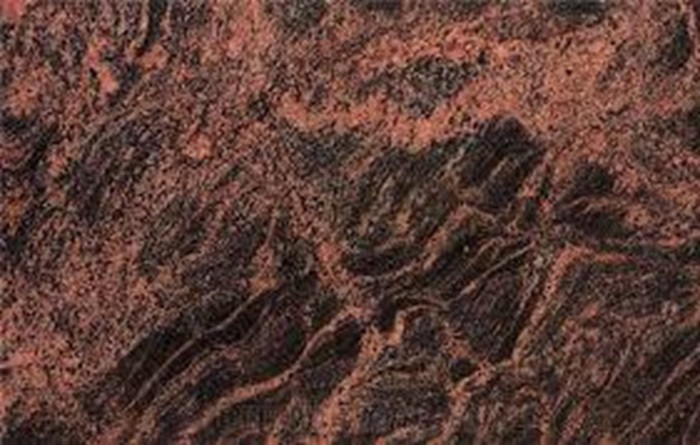
Indian Aurora Granite is a striking export-grade stone prized by architects and bulk buyers for its dramatic reddish-brown and black veins. Originating in southern India, this granite variety is often highlighted by leading marble & granite suppliers and exporters as a showcase of the country’s premium stone quality. Its allure comes from genuine geology, not marketing. The stone’s unique colors and patterns are the result of a complex metamorphic history and mineral mix. In what follows, we explain how Indian Aurora forms, what minerals give it color, why slab patterns can vary so widely, and how suppliers inspect and grade it for export. We also discuss its durability properties and why it is considered an export-quality granite suitable for demanding projects.
Geological Origins of Indian Aurora Granite
Indian Aurora Granite is not a simple igneous granite but a metamorphic gneiss also known as migmatite formed deep in the earth’s crust. It comes from the Precambrian basement rocks of peninsular India, specifically regions of present-day Telangana where it is quarried. In geological terms it is extremely old, formed hundreds of millions of years ago. During early crustal evolution, high-grade metamorphism and partial melting of earlier rocks created this material.
The result is a mixed rock where darker mica-rich bands coexist with lighter quartz and feldspar zones. This process produced a migmatite, a stone that shows both metamorphic and igneous characteristics. Such origin is relatively uncommon among commercial granites and gives Indian Aurora its distinctive geological identity.
Mineral Composition and Texture
Indian Aurora Granite contains the core minerals typical of durable granite but in a specific balance. The primary components are quartz, alkali feldspar, and plagioclase feldspar, which form the light-colored background of the stone. These minerals are responsible for the granite’s strength and polish retention.
The darker areas consist mainly of biotite mica, which creates the deep brown to black streaks and patches visible across slabs. Minor accessory minerals may be present but do not affect performance.
The stone is coarse-grained and tightly bonded. This mineral interlocking gives Indian Aurora Granite high density and long-term structural stability. The texture reflects slow cooling and sustained pressure conditions, which is why the stone performs well in heavy-use applications.
Unique Color Palette and Veining
Indian Aurora Granite is known for its warm, earthy color range. Slabs typically display a reddish-brown or copper-toned base intersected by dark mineral veins. In some sections, the stone appears almost black, while in others it shows rich brown or muted red tones.
The veining does not follow straight or predictable lines. Instead, it appears as broad waves, irregular bands, or flowing zones. These patterns are natural results of mineral distribution during formation and are not surface-level effects.
Because of this natural structure, Indian Aurora Granite is often selected for feature installations where movement and contrast are desired rather than uniform flat color.
Pattern Variation Across Slabs
Variation is an inherent trait of Indian Aurora Granite. Even slabs cut from the same block can show noticeable differences in pattern intensity and color balance.
This happens because the stone contains alternating mineral zones. Depending on where and how a block is cut, different sections of these zones are exposed. A slab cut parallel to mineral alignment may show long flowing bands, while another cut at a different angle may display broader patches.
For bulk buyers, this makes slab selection and grouping essential. Experienced suppliers sort slabs by visual similarity to ensure that shipped lots maintain reasonable consistency across projects.
Industry Quality Practices
Reputable exporters follow strict inspection standards for Indian Aurora Granite. Blocks are examined before cutting to ensure structural integrity and acceptable color distribution. After cutting, slabs are checked for thickness accuracy, surface finish, and visible defects.
Color tone and grain consistency are evaluated under natural light. Slabs that fall outside acceptable variation ranges are separated. Only those meeting export-grade expectations are packed for shipment.
An experienced export-quality granite slab supplier documents these inspections to provide confidence to international buyers. This process is critical for large-scale projects where visual continuity matters.
Export-Grade Durability and Structural Strength
Indian Aurora Granite is valued not only for appearance but also for performance. Like other high-grade granites, it is hard, dense, and resistant to abrasion. Its surface resists scratching and holds polish well over time.
The stone has high compressive strength, making it suitable for flooring, staircases, countertops, and exterior applications. Water absorption levels are moderate and easily controlled through proper sealing.
These physical properties explain why Indian Aurora Granite is widely accepted for export and why it performs reliably in different climates and usage conditions.
Why Bulk Buyers Value Indian Aurora Granite
Bulk buyers prioritize predictability, durability, and honest representation. Indian Aurora Granite meets these expectations when sourced responsibly.
Its geological structure allows for long-term performance. Its natural variation adds visual depth. And when handled by a knowledgeable marble & granite supplier and exporter, it can be delivered in consistent lots suitable for large installations.
Buyers who understand the stone’s natural characteristics are better equipped to plan layouts, approve samples, and avoid disputes.
Conclusion
Indian Aurora Granite is the product of genuine geological processes that occurred deep within the earth over vast time periods. Its mineral composition, grain structure, and pattern movement are all natural outcomes of those conditions.
There is no artificial enhancement behind its appearance. Its value comes from authenticity, strength, and natural visual complexity.
For bulk buyers, understanding the real geology behind Indian Aurora Granite leads to smarter sourcing decisions and better project outcomes. When selected carefully and supplied by an experienced exporter, this stone delivers both visual impact and long-term reliability without needing exaggeration or unrealistic claims.